J.L. Carr, A Month in the Country (1980). Re-issued in Penguin Classics 2016

Another literary outing…this time to Thirsk in the Vale of Mowbray in pursuit of a 1920 Oxgodby where the damaged Birkin – inexperienced restorer of medieval murals and veteran of Passchendaele, and Moon, nascent archaeologist with a Military Cross and Court Martial – were healing through flights of fancy. Neither man existed of course, except in the imagination of JL Carr. I don’t know what John and I expected to find, but whatever it was lay beyond the next village, on the far side of the Vale, soaring over the White Horse; tantalisingly, satisfyingly, out of reach.

We garnered clues, first at the local library, and then at the book cafe in Thirsk’s main square, where we pored over text and map. We drew up a sketchy itinerary based on nothing more than rumours and our own whims and inclinations. We wanted to believe it was Coxwold with it’s defunct station where Birkin arrived from London. But a recommendation from the shop assistant threw us pleasingly off track and we headed for Husthwaite, which had as good a claim as anywhere to the mantle of Oxgodby by virtue of an amateur performance of A Month in the Country at the village hall earlier in the year.
Husthwaite was a quiet village – where infrequent vehicles passed along empty roads strewn with horse manure – with a view of the White Horse etched into the distant hills. Could this be Oxgodby church, with its honey-coloured local stone proudly flying the Ukrainian flag? Standing in the church admiring the chancel’s arch I imagined myself – me, a man with no discernible artistic talent – gazing up at the Last Judgement mural restored by Birkin. Why wasn’t it there? John punctured my daydream by announcing ‘It can’t be Oxgodby church, it feels too splendid somehow. Perhaps we should be at Coxwold?’
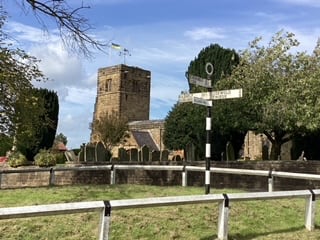
We jettisoned thoughts of following the footpath behind the church in search of Moon’s archaelogy, and off we went, John motoring happily through the countryside on to Coxwold and Kilburn, both with very grand churches – still too grand for the fictional Oxgodby church. Then to Oldstead in the foothills below the White Horse of Sutton Bank, where we embarked on another pleasent wild goose chase – this time on foot, huffing and puffing up ‘the long curving hills lifted from the plain’ imagining ourselves following the horse and trap of Birkin’s Sunday School Treat, where the chapel group picnicked within touching distance of the White Horse. John optimistically gasping, ‘Oh it must be over there on that other hillside’. Of course, it wasn’t. Or it maybe it was, hidden by the countless post-war conifers.

We took another look at the map, there was an ‘Osgoodby Hall’ near Kilburn. Surely this must have a connection with Carr’s Osgodby? It raised hopes of finding the dilapidated Hall of the story – residence of the late Miss Hebron, sponsor of Birkin’s scraping of paint and Moon’s digging of trenches. The shadows were growing longer, it was on our route back to Thirsk, or could be, so off we raced, only to be disappointed by a beautiful, but modernised Hall.
Back at Thirsk rail station – another anomaly as it’s miles out of Thirsk – I pondered whether we should, after all, have explored the footpath behind the church in Husthwaite in search of Moon’s tent? But who could ever know which village, church, baluster, belfry was Oxgodby? Where did the Ellerbeck family live? Was it at this station house? Where was the Methodist chapel to which the non-believer Birkin grew so attached?
It might make more sense to head for the town of Kettering, where the man wrote his books, stealing locations from the corners of his mind, using ‘whatever happens to be lying around in memory’ – a churchyard in Norfolk, a church in Northamptonshire, a vicarage in London, from wherever he could create the elusive Osgodby in his elusive Vale of Mowbray. But it didn’t really matter, it wasn’t the finding, but the searching, wandering pleasingly through Carr’s imagination and the fiction of Birkin and Moon’s missed opportunities, while finding time to indulge in missed opportunities of our own.
Robert Butroyd & John Bromley
 Places and Cultural Traces
Really enjoyed this literary psychographic meander. I have never heard of the book but will have to pick one up now. I spent a year in that area in the very late 90s and know it well so it was nice to be reminded of a place that’s part of my own story and see it afresh through a re-exploration of J.L. Carr’s characters. Thanks!
LikeLike
Month in the Country would have passed me by, but John gave me a copy and I’m so pleased he did. If you do get round to reading it I suspect you will go back to it time and again. If it is not for you at least at 110 pages (Penguin 1980) it won’t take up too much of your time. I wouldn’t normally recommend Kindle, but Kindle Penguin Classic Edition has a fascinating (to my mind) Introduction by Penelope Fitzgerald. A gem of a book written by a determined working class autodidact (the type disparaged by Virginian Wolf). Cheers, Bob
LikeLike