Herbert Whone (1975).
Review by John Bromley.
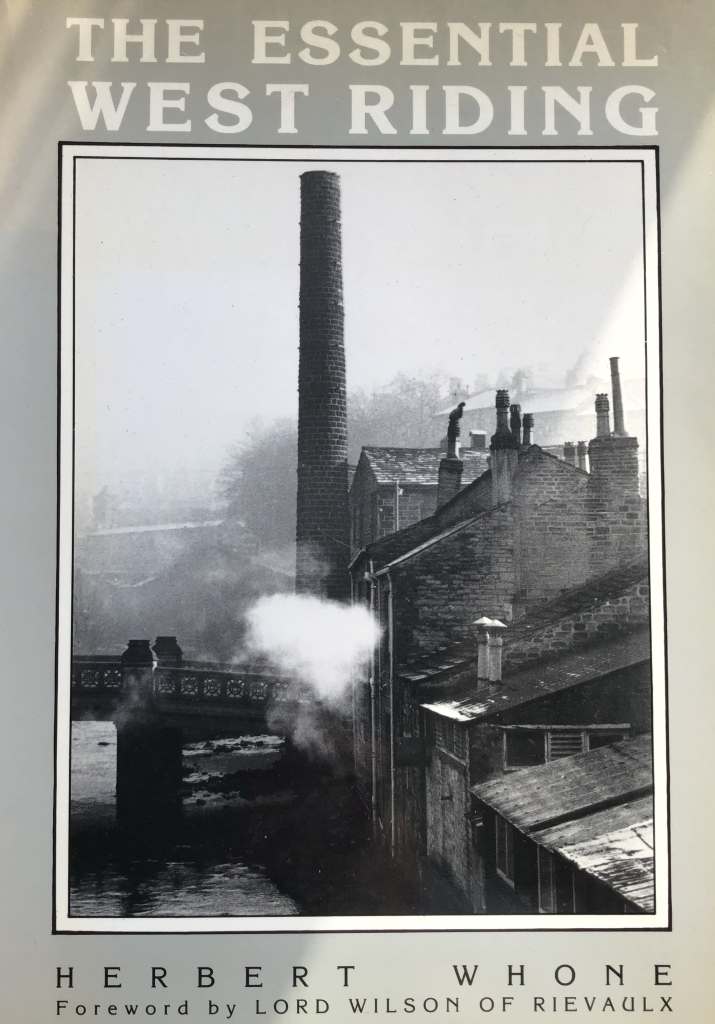
The Essential West Riding is a pleasing mix of photographs and texts by J.B. Priestley, Emily Brontë and Phyllis Bentley, among others, with a foreword by ex Labour Prime Minisiter, Harold Wilson. The photographs are monochrome and starkly characterful of countryside, street settings, factories, rivers and canals. Purposely Whone has not included people as he wanted the book ‘to capture the essence of the area’ and the inclusion of people ‘would have localised the book to a few years in time’. (xii)
Writing his introduction to the book in 1974 Whone refers to the profound changes afoot ‘in this strange landscape’. ‘Everywhere progress was encroaching upon its beauty’. Even the official name ‘West Riding’ was being deleted from official use in that year. (xii)
The images from the early 1970s illustrate the decline in industrial buildings, chapels and housing, to make way for motorways, blocks of flats and what Priestley describes in his Foreword to the 1975 edition as: ‘unsuitable buildings, often looking as if they were dreamt up in Los Angeles’. For him the West Riding towns even with their blackened stone had ‘a certain dignity, even a touch of beauty’. (x)
Blackened stone buildings were something I found quite shocking when I arrived in Bradford in the autumn of 1970. The prevailing damp weather added to the mood. I remember the huge slabs of sandstone of which Bradford’s Exchange Station was made, blackened by decades of steam engines. It was also a period when sandblasting companies were very busy cleaning the smoky grime off the city’s prominent buildings such as City Hall, the Wool Exchange and St George’s Hall. In time home-owners and landlords were keenly following suit.
The Calder Valley became a familiar area to my wife Margaret and myself in the 1970s. It was one of the routes by train between her family home in Bolton and Bradford. Some of Whone’s images remind me of the run-down state of Hebden Bridge at that time due to the drastic decline in the textile industry. Industrial buildings were closed-up and housing was very cheap.
As Priestley notes (x), Whone’s images give the West Riding a sombre air. In the last 50 years that gloom has lifted due to a more diverse economy, in many instances utilising and adapting former industrial buildings. Dean Clough Mills, Halifax and Salts Mill, Saltaire are notable examples of diversification providing work and living spaces.
Fifty years on it is good to look back on Whone’s record and match it against profound changes in the area. Monochrome photographs of landscapes and buildings are matched to snippets of poetry and prose, portraying communities and ways of life that, for better or worse, belong to history.
Editions:
First published 1975 by EP Publishing Ltd.
New edition 1987 by Smith Settle
 Places and Cultural Traces
Thank you Bob.
<
div>It looks and sounds good. It’s nice the way it’s evolved. I can’t remember why I started
LikeLike