John Bromley
On a dull April day, Bob and I arrived by train into Northallerton. The historic Station Hotel was our first stop to refresh ourselves and make a tentative plan. Then we wandered towards the town. Our search for the United Reform Church’s Secret Garden in which to eat our picnic lunch was frustrated by a padlock on the gate. Something else that was closed was the Joe Cornish photographic gallery. Joe’s hopes, for continuation of the building as an arts centre seems – judging from the ‘For Sale’ sign – unlikely to materialise.
We knew we wished to visit the Heritage Hub at the top of the High Street. We received a warm welcome there, where a friendly and informative volunteer told us about Northallerton prison, a significant feature of the town from 1788 up to 2013. I spotted a small book titled ‘House of Care’ with the image of a human treadmill on the cover. Reacting to our shock at the image the volunteer told us treadmills in prisons weren’t always a negative thing, it could help prisoners to develop fitness which, coupled with regular meals, enabled them to achieve a better standard of life than was often available outside the prison. The power generated by the treadmill was used to grind grain and to pump water for use in the prison.
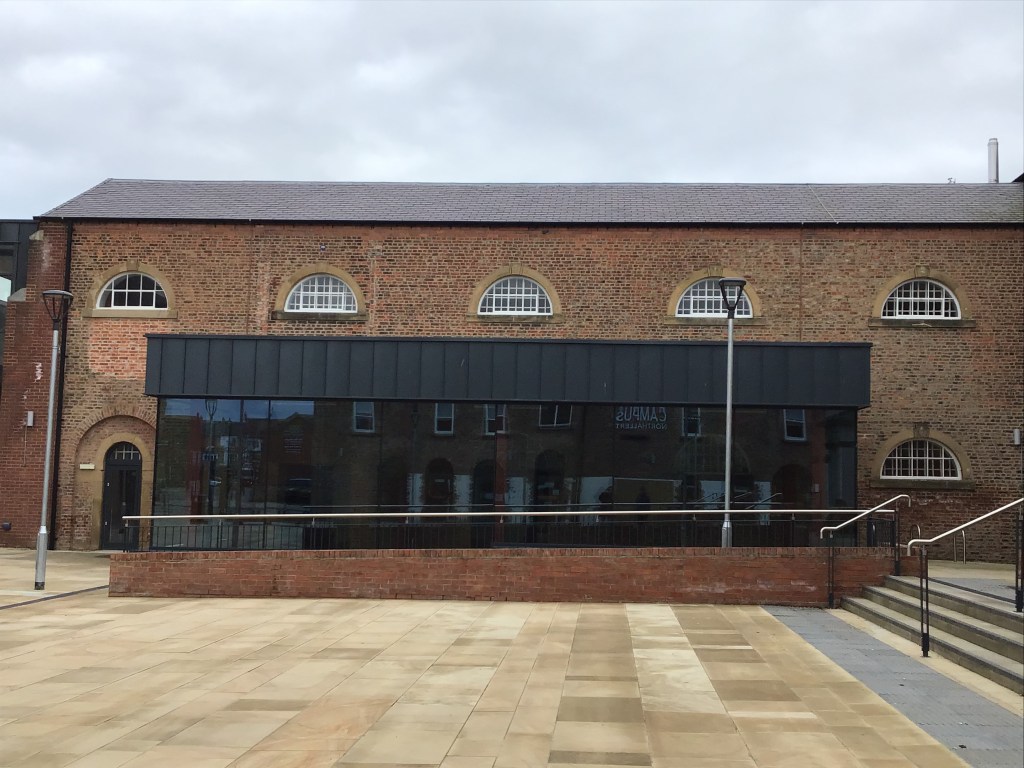
Following our visit, I did more reading. Contrary to what we heard on the day, treadmills were used as a form of hard labour to the point where, on occasions, prisoners died walking the treadmill. So to us – from a supposedly more enlightened perspective – it seems perverse that the property development now carries the title ‘Treadmills’. As if former suffering is irrelevant to present commercial branding. The story of Sophia’s imprisonment made me wonder whether families were ever accommodated in Northallerton prison.
In Charles Dicken’s ‘Little Dorrit’ the central character Amy is born in the Marshalsea debtor prison, then lives in the prison alongside her father for over 20 years, as described so starkly below:
‘This was the life … of the Child of the Marshalsea…. With a still surviving attachment to the one miserable yard and block of houses as her birthplace and home…. Since she had begun to work beyond the walls, she had found it necessary to conceal where she lived, and to come and go as secretly as she could, between the free city and the iron gates outside of which she had never slept in her life.’*

This was not a unique situation as historically the ‘coverture’ system meant married women did not have independent legal property status. As a result it was sometimes easier for women and their children to move into prison to live alongside the debtor husband.
Rather sombre thoughts as we returned to Northallerton Station; determined to come back to find out more about Northallerton’s hidden working class.

*Charles Dickens (2008: First published 1855-57) ‘Little Dorrit’ Vintage Books:78
 Places and Cultural Traces