By John Bromley

Botton is ‘a place apart’, deep in North Yorkshire’s Danby Dale surrounded by hills on three sides. Nestled in the dale is Camphill, a community influenced by Rudolf Steiner. It was and is, – through the newer Esk Valley Camphill Community (EVCC) – an approach to care and life support within ‘a family setting’.
I first visited an open day in the 1970s. I returned as a volunteer for a weekend in Autumn 2022. I was a guest at one of the EVCC houses, sharing meals and company. I visited again in Summer 2024 to receive hospitality from a couple who have spent over 50 years living and working as core members of Camphill Community.

On my way to Botton I stopped at the Ryedale Heritage Museum, at Hutton-ie-Hole, a site of rebuilt buildings amidst small meadows and grazing sheep. I viewed an exhibition about local myths and spells, offering a ‘window’ onto a diverse local history and heritage. Later, as the road traversed extensive heather moorland I saw rough-hewn standing stones parallel to the road – historical road signage. I climbed higher and the breeze strengthened, noticeable even in the comfort of the car.

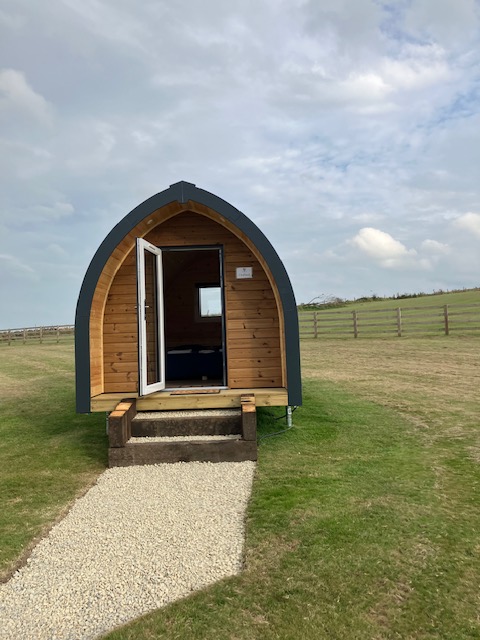
After the open moorland it was a relief to reach Castleton, spread across hillsides at around 700 feet. The next settlement at a lower elevation, where I was ‘camping’ for 2 nights, felt like a safe haven but with the wind still evident. The glamping pod had a pleasant aroma emanating from the pine wood. Next morning, I made my way to a former shooting lodge, which is now the National Park Centre for the North York Moors. I browsed around, listening to an audio presentation about the tough lives of ironstone workers and communities in the surrounding area. As ironstone seams ran out, mines closed, creating widespread poverty.
J.C. Atkinson, who presided over Danby parish from 1850 until 1890, took a deep interest in local history, folklore and natural life, evident in his classic ‘Forty Years in a Moorland Parish’. Atkinson, born in Essex, spent 3 years in Scarborough before being offered the ‘living’ of the Danby parish. His chapter on ‘Hills and Dales’ compares the five dales to a set of fingers pressed into a cake mixture. In addition to Danby Dale, there is Westerdale, Little Fryup Dale, Great Fryup Dale and Glaisdale. Four of these are encompassed by hills and moorland, with openings to the north giving access to the valley of the River Esk: a spectacular landscape.
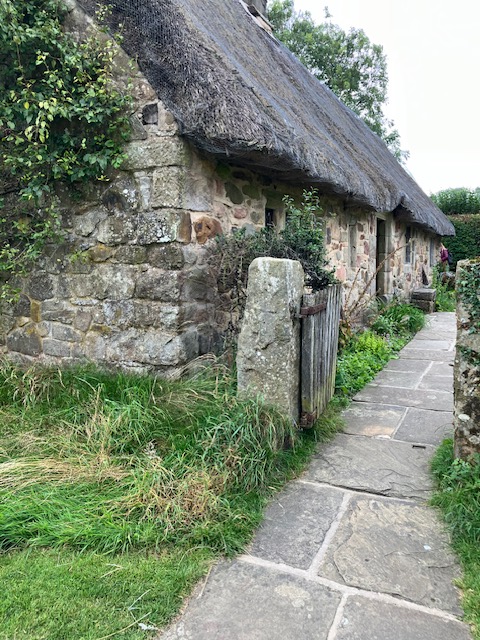
Throughout its history the Botton area has been a place of refuge. Even though it’s only 5 miles from Castleton and 18 miles from Whitby during my time in the dale I had a sense they hardly existed. From the mid-17th Century the seclusion suited some Quaker families to acquire land for farming. Then from 1954 the location attracted the Camphill Community for establishing houses, workshops and farms.

After lunch at one of the community houses I set off home feeeling sad as I climbed up the hill to High Crag and the moorland road. I stopped the car and looked back but the density of the trees in full leaf obscured the specific places I had visited. It seemed strange to leave this place of historical refuge in its distinctive setting, as I anticipated my journey home across the bleak moors.
Notes
Camphill Community principles: equality in social cooperation; freedom in spiritual and cultural life; and fellowship in economic life.
EVCC: ‘A community of fourteen households in Danby Dale. We share our homes and our lives. The elderly person, the busy working adult and the small child each has their own place within the community, and we are all enriched by our daily interactions.’
Rudolf Steiner advocated learning for the intellect, artistic and practical skills.‘
Countryman on the Moors’, John C. Atkinson, edited by John G. O’Leary, 1983, Oxford University Press.
 Places and Cultural Traces